Part 3 of Understanding the Tax Impact: How Much Is a Data Center or Private Power Plant Actually Worth?
In Part 1 of this series, we explained how property taxes are calculated in Nebraska.
In Part 2, we looked at how homes, farmland, businesses, and industrial property are valued today.
Now we're ready to tackle one of the biggest questions in this discussion:
If a large privately owned power plant or data center were built in Cass County, how much would it actually be worth for property tax purposes?
This is one of the most important pieces of understanding the overall tax discussion.
First, a Few Important Clarifications
Before diving into the numbers, we want to make something very clear.
At this time:
There is no formal application before Cass County for a data center.
There is no formal application before Cass County for a privately owned natural gas power plant.
There are no publicly released construction plans showing the final size, design, or cost of a future project.
Tenaska is in the early exploratory stage of power plant development
Because those details do not yet exist publicly, everything discussed in this article is educational and uses publicly available industry data and construction estimates—not a specific proposed project. Our goal is to explain how these types of facilities are valued, not to state that a future project will have a particular value.
How Is Industrial Property Valued?
When someone builds a house, determining its value is fairly straightforward. There are usually many similar homes nearby that have recently sold. A county assessor can compare those sales to estimate market value. Large industrial facilities are different. There aren't many comparable sales for a billion-dollar power plant or hyperscale data center. Because of that, assessors often rely heavily on what's known as the Cost Approach.
The Cost Approach
The Cost Approach asks a fairly simple question:
"What would it cost to build this facility today?"
The assessor then considers:
Construction costs
Site improvements
Buildings
Mechanical systems
Electrical infrastructure
Cooling systems
Land improvements
Depreciation
Functional obsolescence (if applicable)
For unique industrial facilities, this is often the primary valuation method because there simply aren't enough comparable sales to rely on.
Real Property vs. Personal Property
Another important concept is that industrial facilities are often divided into two taxable categories.
Real Property
Real property generally includes:
Land
Buildings
Foundations
Roads
Parking areas
Electrical infrastructure
Cooling systems
Permanent mechanical equipment
Utility improvements
This property is generally assessed near market value.
Personal Property
Personal property includes equipment that is not considered part of the real estate itself.
For a data center, this can include:
Servers
Computer racks
Network equipment
Switches
Specialized electronics
Nebraska taxes this equipment differently.
Instead of market value, personal property is generally assessed using net book value, which reflects original cost and statutory depreciation schedules. Because technology becomes obsolete relatively quickly, much of this equipment depreciates faster than buildings.
How Much Does a Modern Data Center Cost?
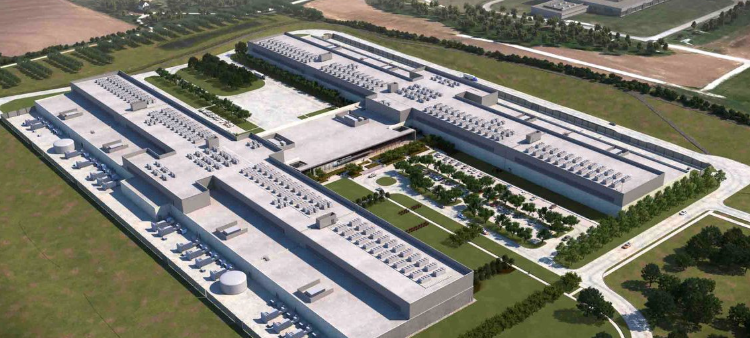
Today's hyperscale data centers are among the largest private construction projects in the world.
Industry reports from firms such as JLL and Cushman & Wakefield estimate that modern hyperscale data centers typically cost approximately:
$10 million to $12 million per megawatt (MW)
Some AI-focused facilities requiring advanced cooling systems may cost even more.
For example...
A 200 MW hyperscale data center could represent a construction investment of roughly:
$2 billion to $2.4 billion
A 500 MW hyperscale data center could represent construction investment of roughly
$5 billion to $6 billion
Larger campuses containing multiple buildings often expand over time and may eventually represent several billion dollars in total investment.
How Large Are Modern Google Data Centers?
Google rarely publishes detailed specifications for individual facilities. However, independent industry research estimates that many recent Google hyperscale facilities operate within these approximate ranges:
Facility | Estimated IT Load |
Mesa, Arizona | ~90–183 MW |
Midlothian, Texas | ~103 MW |
The Dalles, Oregon | ~154 MW |
Papillion, Nebraska | ~237 MW |
Council Bluffs, Iowa | ~237 MW |
Columbus, Ohio | ~303–386 MW |
Many Google campuses consist of multiple buildings that continue expanding over time.
Several recently announced campuses are expected to exceed:
500 MW to more than 1 Gigawatt
For our calculations, we will use 500 MP and $5 billion. Again, these examples are provided only to illustrate the scale of modern hyperscale facilities.
What About a Natural Gas Power Plant?
Large combined-cycle natural gas power plants are also extremely valuable industrial assets. Construction costs have increased significantly in recent years due to inflation, labor shortages, equipment demand, and supply chain constraints.
Recent industry estimates place construction costs approximately between:
$2 billion and $5 billion
for a modern 2,000 MW combined-cycle natural gas generating facility, depending on technology, design, and market conditions.
Like data centers, these facilities are generally valued using cost, income, and market approaches, with the Cost Approach often serving as the primary starting point.
Why Do These Numbers Matter?
At first glance, billion-dollar construction costs may seem difficult to understand. But remember what we discussed in Part 2. Every taxable property contributes to the county's total tax base.
When a county adds a property valued in the billions of dollars, that property becomes part of the overall taxable valuation used by local taxing entities.
This does not automatically determine anyone's future tax bill.
However, it can significantly change the composition of the county's tax base. That is why conversations about large industrial development often focus on valuation.
Construction Cost Isn't the Same as Taxable Value
Another important distinction: Construction cost and taxable value are not always identical.
Actual assessed values depend on numerous factors, including:
Final construction cost
Depreciation
Market conditions
Equipment values
Applicable Nebraska assessment rules
Local property characteristics
Each facility is appraised individually.
Because no formal proposal currently exists in Cass County, it is impossible to know what the final assessed value of any future project would be. Any discussion today is necessarily based on industry benchmarks and publicly available information—not a completed appraisal.
Why We're Sharing This
We've heard many conversations suggesting that a future industrial development would simply be "worth billions."
While that may generally be true in terms of construction investment, understanding how those values are determined provides much more useful context than simply repeating a headline number.
Understanding valuation helps explain why large industrial developments receive so much attention in discussions about local government finance and property taxes.
Coming Next
Now that we've explained how these facilities are valued, we're ready to answer another important question:
In Part 4, we'll explain the difference between:
Publicly owned power plants
Privately owned power plants
Public utilities
Private industrial facilities
We'll also explore why ownership affects how property taxes are collected and why that distinction has become part of the current discussion surrounding LB 1261.
Sources
This article is based on publicly available information from:
Nebraska Department of Revenue – Property Assessment Division (commercial and industrial property assessment guidance)
Cass County Assessor's Office
Nebraska Revised Statutes, Chapter 77
JLL Data Center Outlook & Construction Cost Reports (2025–2026)
Cushman & Wakefield Data Center Market Reports
BloombergNEF reports on combined-cycle natural gas power plant construction costs
U.S. Energy Information Administration (EIA) engineering cost estimates for combined-cycle generating facilities
Industry analyses of hyperscale data center development and capacity (2025–2026)
Note: The facility values discussed in this article are industry estimates used for educational purposes. They are not appraisals of any proposed project in Cass County. Because no formal development application has been submitted, no official assessed values currently exist for a future power plant or industrial facility.


